Break the Bank
About the race
Break the Bank 50 Miler takes place on Saturday, October 9, 2027 at 8 a.m., offered as a 50 mile solo or relay event.
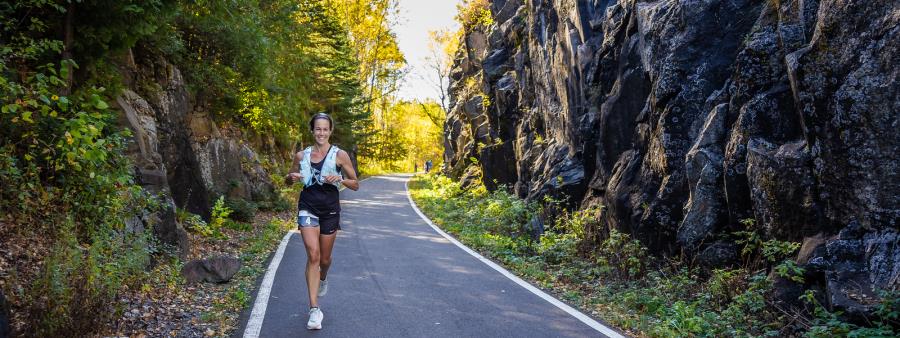
The race follows the scenic Willard Munger Trail from Sturgeon Lake, Minnesota to Duluth, Minnesota, with lush forests, picturesque lakes, bridges and rocky terrain carved out by the last ice age. The course finishes with a rewarding downhill run over the last 10 miles.
Break the Bank 50 is committed to growing the sport through the inclusion of runners who have historically been denied or discouraged from racing. There is no discrimination allowed at the race, and all are welcome as long as they treat others with respect.
Age Groups
Aid stations
Break the Bank Ultra has ten (10) aid stations along the course, offering water, energy drinks, cookies, energy gels, Salted Nut Rolls, assorted sodas and other refreshments. All ten aid stations also serve as relay exchange zones for 2-person and 5-person relay teams.
Cups are provided at every aid station, so runners do not need to carry their own. Runners who bring a refillable bottle or cup can have it refilled by volunteers.
Aid station locations
- Aid Station 1 – Mile 6.9: Sturgeon Lake, Munger State Trail Parking
- Aid Station 2 – Mile 12.45: Moose Lake, 200 Arrowhead Lane
- Aid Station 3 – Mile 17.35: Barnum, Munger State Trail Parking
- Aid Station 4 – Mile 23.35: Mahtowa, Munger State Trail Access
- Aid Station 5 – Mile 27.55: Across from the Elmwood Inn, Munger Trail
- Aid Station 6 – Mile 32.0: Douglas Road Crossing, Munger Trail, west of Carlton
- Aid Station 7 – Mile 35.75: Carlton, Munger State Trail Parking
- Aid Station 8 – Mile 40.25: Peterson's Aid Station Trailhead, Munger Trail
- Aid Station 9 – Mile 42.65: Buffalo House Trailhead, Munger Trail
- Aid Station 10 – Mile 45.35: Just before "The Slice", Munger Trail
Finisher awards and safety deposit boxes
Every finisher receives race medals and a race shirt. Every finisher also chooses a random safety deposit box inside the bank at the finish line. The boxes hold prizes ranging up to $500, along with other awards. Finishers receive a key.
Race transportation
Transportation is provided for all participants from the finish line (Bank House, 1106 88th Ave W, Duluth, MN, 55808) to the start line in Sturgeon Lake on the morning of the race. Using the buses (free of charge) is strongly encouraged to reduce congestion near the start.
- Buses depart from the finish line (Bank House) to the start at 6:20 a.m.
- Boarding begins as early as 6:00 a.m.
- Buses remain on-site at the start line until 7:45 a.m. and provide shelter if the weather is less than ideal.
Outdoor heaters and tents are also available at the starting line to keep runners warm and sheltered.
Warm-up clothes are transported back to the finish line after the race begins. Place warm-up items in a bag for easy transport.
Packet pickup
Packets can be picked up at The Bank House, the finish line, on the Friday before race day. Packets are also available at the start location the morning of the race.
Prizes and records
Break the Bank offers the following:
- $10,000 to any individual who sets a new 50-mile American best for their gender.
- Men's 50-mile record: 4:48:21, set by Charlie Lawrence in 2024 at the Tunnel Hill 50.
- Women's 50-mile record: 5:31:56, set by Courtney Olsen in 2024 at the Tunnel Hill 50.
- There is currently no record for non-binary runners. The race will adjust accordingly.
Open division places
- First place: $300
- Second place: $200
- Third place: $100
Course record: $200 for anyone who sets a new course record for male, female or wheelchair.
Entry limit and questions
Race limited to the first 150 solo runners. Questions and thoughts can be directed to Jeff Allen (RD) at runjeffrun50k@yahoo.com or 651-332-9988.
2026 winners: Cooper Mumford 5:48:52, Rachel Ragona 6:48:47, Nathan Phillips 4:31:05.
Relay teams
Break the Bank welcomes both 2-person and 5-person relay teams. All ten aid stations are designated relay exchange zones, giving teams flexibility in how they divide the course.
How relay exchanges work
- Teams may determine their own running order and assign segments however they choose.
- Runners may complete multiple consecutive segments before exchanging with a teammate.
- Teams may alternate runners at every aid station, every other aid station (the most popular option), or any combination that works for the team.
- There is no requirement for each runner to complete an equal number of miles or segments.
- All relay exchanges must take place at designated aid stations.
- Hand-offs are done with an energetic high five.
For example, a 2-person team may alternate runners at every exchange, while a 5-person team may divide the course into longer or shorter segments based on each runner's preferences and abilities.
Relay transportation and logistics
- Relay teams arrange their own transportation to and from exchange zones. Race organizers do not provide shuttle transportation.
- All ten aid stations are available for relay exchanges. Teams should plan their transportation and exchange schedule before race day.
- Each relay team opens one safety deposit box at the finish line.
Relay runners should communicate with teammates and arrive at their designated exchange location before the incoming runner reaches the aid station.
What your entry includes
Cancellation policy
Athletes can cancel their registration, but no refund is given.
Refunds, transfers to other runners and exceptions are not permitted. If the event is cancelled and cannot be rescheduled, no refunds, race credits or rollovers are given.
The course
The race is a point-to-point 50 mile course on the Willard Munger Trail, from Sturgeon Lake to Duluth, Minnesota. The course is nearly flat for the first 40 miles and finishes with a gradual downhill over the last 10 miles. The trail is paved and runs past lakes, forests and bridges.
Course description and finish
Approximately 43 miles of this point-to-point race will be run on the Willard Munger Trail, a paved trail. The course is nearly flat for the first 40 miles, with a gradual downhill finish featuring a 500 foot drop over the last 10 miles.
The finish is next to a bank built in 1918 which has been converted into a home and, for the race day, the HQ and finish of the race. Warm showers, music, a warming tent, and food and drink will be available at the finish.
Race weekend schedule
Location
Duluth MN, Duluth, MN, USA Open in Google Maps
City insight: Duluth
Duluth is a port city in the U.S. state of Minnesota and the county seat of St. Louis County, located on Lake Superior in the Arrowhead Region. It is the state's fifth-largest city, with 86,697 residents at the 2020 census, and forms the Twin Ports metropolitan area with neighboring Superior, Wisconsin. The city sits south of the Iron Range and the Boundary Waters Canoe Area Wilderness. Winters are long and cold with heavy snow, while summers are mild and cool because of the lake, so late spring through early autumn is the best time to run or race.
Know from the athletes
Similar races
St. Croix 40 Winter Ultra

The Wolf Within Winter Backyard Ultra

Tuscobia Winter Ultra
Baby Backyard 5K - 50K ULTRA
Collegeville Ultra

Blacks Grove Backyard Ultra Presented by Agony of DeFeet Wadena Run Club
Sisu Backyard Ultra at Lake Rebecca
Lost In The Woods
WausaUltra Solo, Double, Limitless